A Recovering Dispatcher’s Mission to Transform Public Safety
By:
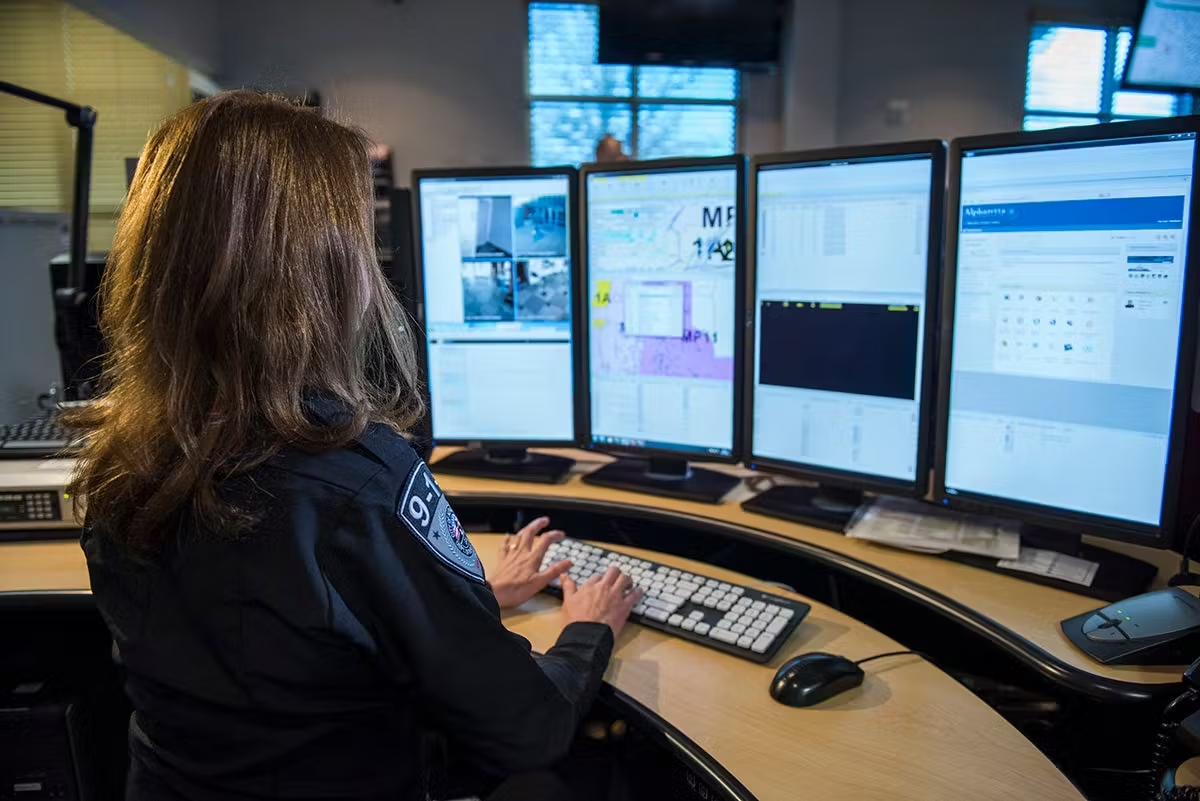
From the Headset to the Frontlines of Innovation
“Hi, my name is Casey Rives, and I’m a recovering dispatcher.” That is how our Public Safety Solution Consultant started her speech at the Innovation Showcase stage at NENA earlier this summer.
Funny as it may sound, this sentence carries the hard truth that every 911 professional is painfully familiar with: the job is tenacious, the stakes are high, and the burnout is real.
At Verint, we fully understand the pressure of public safety professionals as some of our colleagues come directly from the other side of the headset. Having experienced it firsthand, they are now bringing their hands-on expertise from the field to building solutions that can really help solve the challenges 911 employees are facing today.
The Hidden Crisis in 911 Centers
Every day, emergency telecommunicators answer calls that can mean the difference between life and death. But what most people don’t realize is that these same professionals are also handling non-emergency calls, which while important, can clog critical lines, delay life-saving responses, and lead to burnout.
Staffing shortages are at crisis levels at public safety answering points (PSAPs).
According to NENA, over 82% of 911 centers report struggling to maintain adequate staffing. Half of all 911 professionals are working mandatory overtime. Over 70% of responders experience burnout and 40% leave within the first year of employment.
What happens when there really is no one left to answer the call?
Adopting Proven Call Automation Technology to 911
Today’s 911 centers are critically understaffed, but the call volume hasn’t slowed down—and citizen expectations are higher than ever.
In a PSAP that takes one million calls a year, we can estimate that 500,000 of those calls are non-emergency requests, such as noise complaints and parking violations.
What if we could change that? What if we could offload 150,000 of those 500,000 non-emergency calls—just in the first year?
That’s exactly what Non-Emergency Call Automation is designed to do.
At Verint, we’re not reinventing the wheel; instead, we’re adapting proven technology used in 311 centers that handle non-emergency service calls and tailoring it for 911 operations. AI-powered solutions and automation, including voice bots, SMS, web chat, mobile apps, and web portals, can empower citizens to self-serve for non-urgent issues.
Let’s say your car was hit overnight while parked. No injuries, just a dent. You need a report for insurance, but you can’t afford to be late for work. Instead of waiting on hold, you open your city’s mobile app, report the incident, upload a photo, and head to work. An officer follows up later. You’re on time. It’s a win-win for all!
AI that Supports, Not Replaces
Using AI-powered solutions and automation in 911 services can be daunting, but this isn’t about replacing human emergency dispatchers. It’s about empowering them.
AI-powered specialized bots are always available and smart enough to know when to escalate calls to a human. If a caller says, “I need help,” or uses keywords that indicate an emergency, they’re immediately routed to a human dispatcher.
The 911 profession is at a tipping point. We can’t afford to wait. AI can’t perform CPR, but it can ensure a 911 telecommunicator is available to walk a parent through it when every second counts.
Verint is committed to equipping PSAPs with advanced technology 911 telecommunicators need and deserve today. With decades of expertise in automation, compliance, and workforce optimization, our Public Safety solutions are built to improve emergency call handling, automated quality management, and more.
If you’re interested in continuing the discussion about the latest trends and technologies in public safety operations, meet the Verint Public Safety Team at APCO 2025 in Baltimore, July 28-29.
Keep an eye out for our smallest team member, with big brains in a tiny frame, as well as our complimentary ice cream stand.
Until then, learn more about Verint for Public Safety here.