What Makes an AI Call Summary Worth Trusting?
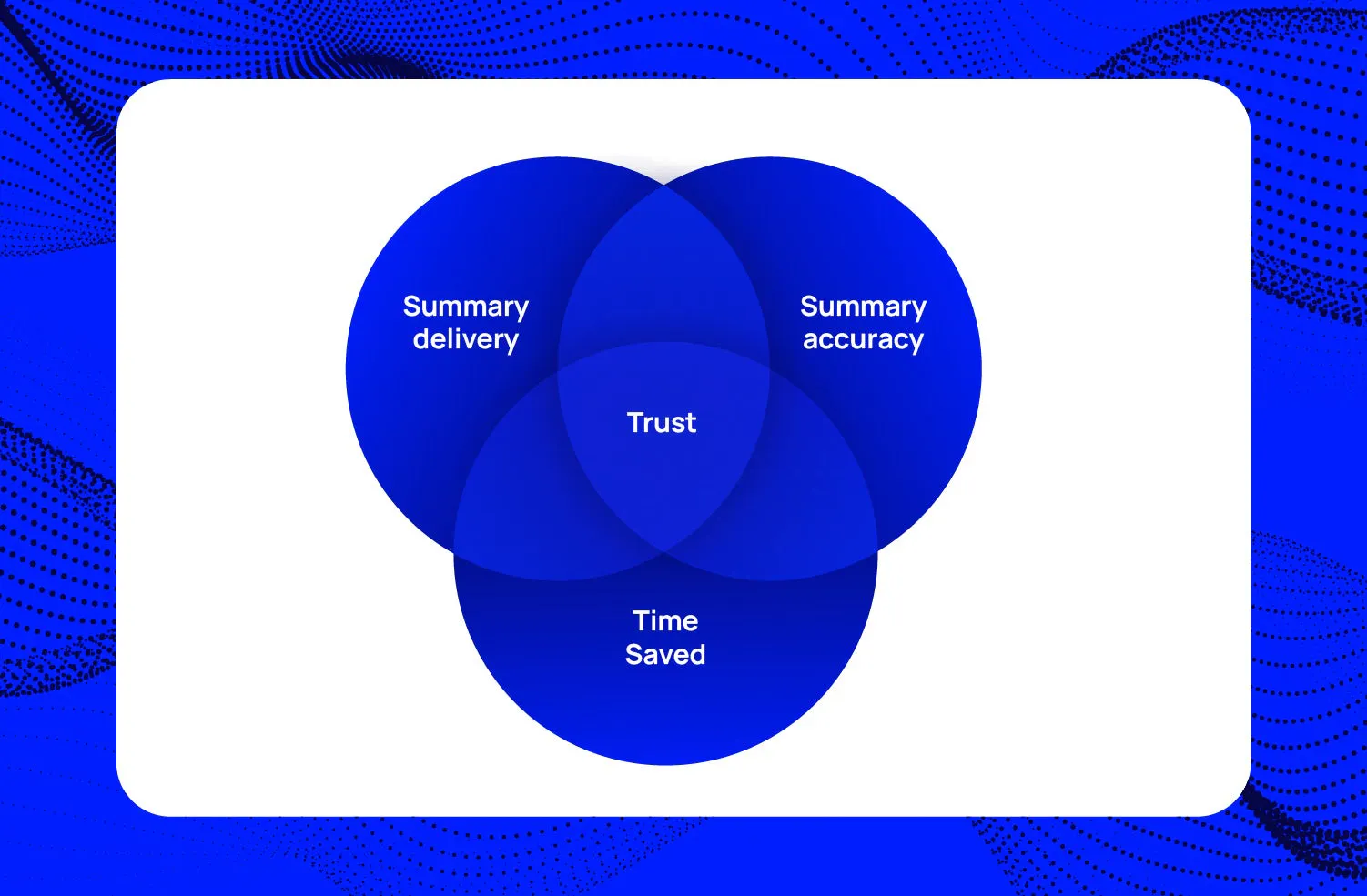
The three circles of a great call summary

With AI investment and innovation continuing to accelerate across call center operations at a blistering pace, most companies are noticing that the outcomes they generate are simply not catching up at the same rate. At Verint we like to call this the AI Reality Check, and it’s why we obsess over delivering positive customer outcomes.
If you’ve been evaluating using generative AI to automate your contact center’s after-call work (ACW), you’ve probability built the same mental model we did at first: a call summary that gets delivered, plus a summary that accurately reflects the call, plus the time it saves your agent on wrapping up a call, all adding up to your return on investment.
Tick all three and you’ve got yourself a business case. Feels good to venture forth!
Except we don’t think about it that way anymore — and the reason why is the difference between AI that demos well and the AI that drives the right outcomes for your organization. Here’s how we actually think about it.
The three circles of great call summary
Let’s imagine a scenario where, after a long call spent troubleshooting a customer’s inquiry, an agent receives a call summary, beautifully formatted with the call outcome and displayed in their agent dashboard the instant the call ends — except one detail in the summary is not quite right.
The agent must now read it, find the issue, re-verify it against their memory of the call, and fix it.
We’ll that’s entirely too slow! We had perfect delivery, but there was real time lost in fixing the issue. The lack of call summary accuracy didn’t just subtract from the tool’s value; it nullified the trust of your agents.
Insights gained from examples like this reframed how we think about summary value. Delivery, accuracy and time saved aren’t three features that add up to an outcome. They’re three circles of equal weight, and the value only shows up where all three overlap. If you let one slip, like the accuracy did above, it will take the others down with it. Keeping them in balance is exactly what the Verint team builds with Wrap Up Bot, so let’s walk through each circle to get a closer look what that means.
Circle 1: summary delivery
An agent performing after-call work needs to get to the next call in their queue quickly. From the time the call ends to the moment the agent commits their disposition and moves on, there is a specific window of time when the call summary is useful.
For agents, the most important aspect of call-summary delivery is that it arrives it to their Agent Copilot dashboard at just the right time. Agents can then copy and paste the summary into their organization’s source-of-truth system, like their CRM, so they have a 360-degree view of the customer interaction should they call in again.
Which means timing is everything!
Here at Verint, when we think about delivery more holistically, we’re looking at it in three main ways.
The first is how fast the summary was generated. We measure the speed-to-summary in terms of time from the moment the call ends to when the summary is available to the agent. Delivery isn’t just about producing the summary; it’s about delivering it to the Agent Copilot UI in a timely way that leaves little left to do for the agent when the call ends.
We measure all of this in Wrap-Up Bot’s Operational Dashboards in Data Insights. Program owners can receive a granular report across different levels of lead time to monitor the healthy delivery of their call summaries. It’s your daily dashboard for making sure your agents are getting the right call summary experience delivered in a fast way.
The second area answers, did every call get a summary? Call summary coverage for our Verint customers with Wrap Up Bot consistently hits in the top quartile for our Service Level Objective (SLO) — and it’s an area we’re proud of. Delivering call summaries at our customers’ scale takes a dedicated team of professionals managing model upgrades and summarization services across the world so that your agents get consistent delivery of summaries even when your concurrent calls are at their highest rate.
But it’s not just the delivery success rate that we’re excited about; it’s that the system is honest about it. Using Wrap-Up Bot’s Operations Dashboard in Data Insights, we show where summaries are expected and missed so that you have a clear view on the health of your deployment. Many ops teams use this dashboard to trigger remediation when delivery drops below a set threshold for a meaningful volume of calls over a defined window of time. In this way, you can quickly address issues to keep a consistent agent experience and maintain trust in the summary delivery system.
The third aspect of summary delivery answers the question: Does it land where agents already work? Summaries must appear inside the workflow the agent is already in, with no context switching. Every tab, every click by the agent compounds over many calls to increase the after-call work, breaking the harmonized and balanced circles in our Venn diagram.
This is exactly why we deliver summaries through the Verint Agent Copilot UI, which unifies our Copilot Bots into a single agent desktop experience in the agent’s active workspace. Rather than forcing agents to toggle between isolated applications, the wrap-up summary appears right where they’re already working.
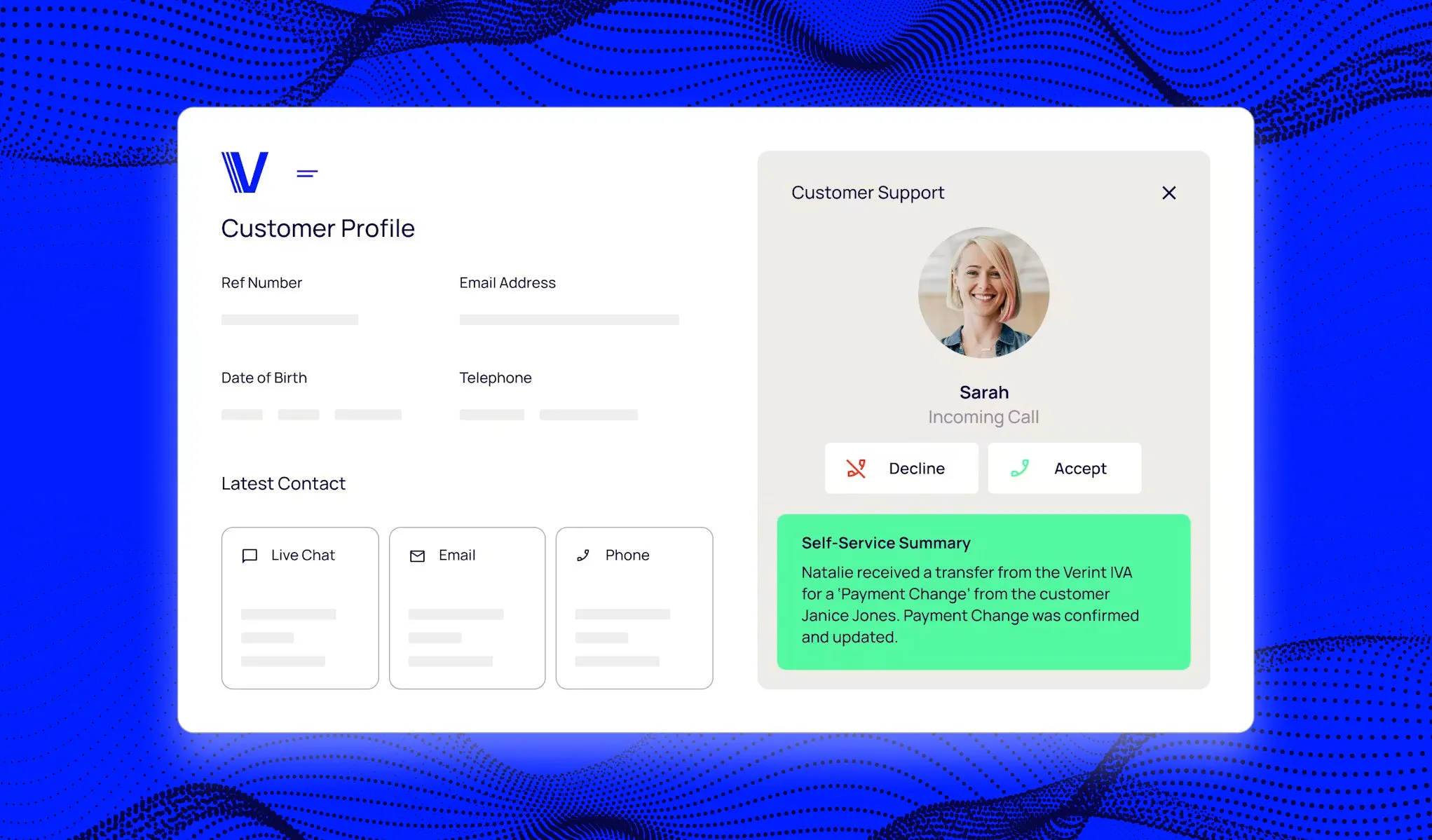
The moment the summary lands in front of the agent, a different question tends to take over — can they trust what it says?
Circle 2: summary accuracy
When it comes to the accuracy of a call summary, Quality Assurance teams in collaboration with our Verint Professional Services team derive a quality score through a human-graded comparison of “what was said” against “what the summary said.” They do this because accuracy only delivers value alongside the other two circles: together they can earn the agent’s trust.
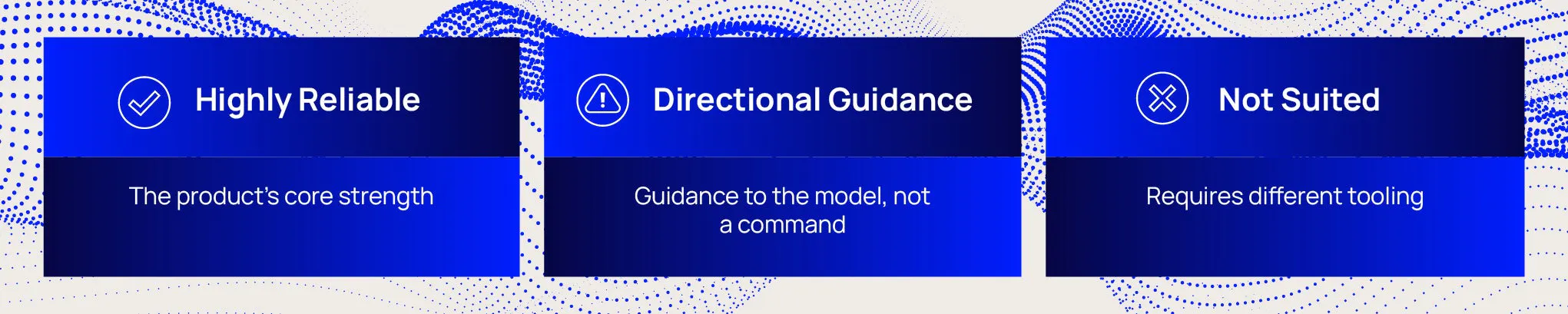
When setting up a customer on Wrap Up Bot, we don’t just look at accuracy as a single percentage — we look deeper, in what we call “tiers of reliability.”
The first tier is what the model is dependably good at, and it’s at the core of how we generate summaries with Wrap-Up Bot. It includes a clear narrative summary organized by topic (rather than the order in which things were said), the primary reason for the call, the key actions the agent took, and the general outcome of the call.
This first tier is the core of the product’s value and is where the after-call savings come from.
The second tier is what the model can be steered toward but is not always guaranteed to produce. Things like producing agreed-upon next steps, extracting specific dates, or prices discussed. Treating this model’s steering capability as if it were able to produce a guaranteed summary of these types of things is exactly how agent trust starts to break down; a couple of misses here and there on the expected summary, and the agent stops believing in the solution.
Finally, the last tier comprises the things Wrap-Up Bot simply isn’t the right tool for. Areas like forcing structured fields used in downstream integrations, call classifications for churn risk, and call compliance verification don’t fit well into Wrap-Up Bot use cases.
These aren’t accuracy problems we can just tune our way out of. Resolution of these problems requires other purpose-built tooling in the Verint ecosystem, like our Transfer Bot, Redaction Bot or Automated Quality Management. While we’re on the subject, I encourage you to check out what the Agent Factory has for agentic AI workflows. It’s mind blowing.
Behind all of this is the idea that accuracy is tunable. That the quality of a summary depends on the instructions behind it, which is why, with the help of Verint Professional Services, we tune the summary generator’s prompt to each business’s definition of “what matters” — and to be delivered in a way that will gain the most trust from your agents.
Are we starting to feel a Zen-like balance of our three circles of a great call summary?
Circle 3: time saved
In their quest to automate, call centers have always been the earliest adopters of artificial intelligence —even before the advent of the large language model and generative AI. Call center automation has been an area of non-stop innovation over many years, and the Verint Wrap-Up Bot is our contribution to that history. We save organizations millions every year by cutting after-call work across the agent base.
Over the course of a call, Verint Real-Time Transcription service listens to every word and creates an accurate transcription. Then, as soon as the call completes, the automated wrap-up process begins: The transcription is fed into Wrap-up Bot, which uses generative AI to produce an accurate summary of the call. Here is where we start seeing the savings realized from automating agent after-call work. In a modeled 1,000-agent contact center, a 60-second reduction in average call duration works out to roughly $7.2 million in annual savings.
The best way to prove after-call-work reduction is ideally through a controlled rollout before you scale up across your agent base. Wrap-Up Bot grows with your organization, tuned to your operation as it scales. One major Telecom customer deployed it for 500 agents before scaling to 15,000, with Wrap-Up Bot now serving roughly 470 peak concurrent transcripts on a daily basis. Getting that right takes serious capacity planning at the scale of your organization. And planning for that peak, in your region, is something we do well. When we engineer the time-saved circle to balance real ACW reduction with the agent experience, all three aspects of call-summary value settle into equilibrium.
Trust is at the center
Look back at the three circles of call-summary value, and you’ll notice the same word kept showing up: trust.
Fast summary delivery matters because a summary that arrives on time, inside the agent’s workflow, is one the agent can rely on.
Summary accuracy matters, and it isn’t just a quality score; it’s tiered, making sure you have the right summary customizations for the job. An agent who believes the summaries time after time gains faith and stops re-checking them.
And time saved shows up in your automation outcomes only when the Wrap-Up Bot experience is rolled out well, and all three circles are given equal weight.
Every circle is really about the same thing — trust — which is why it sits in the center, where all three are in balance.
For every Verint customer, this is the model we use to deliver value with Wrap-Up Bot. It’s three circles kept in tune to drive your AI automation outcomes as fast as possible.
Want to see what this balance is worth your operation? Run your own numbers in our Wrap-Up Bot value calculator.