How Modern WFM Technology Solves Critical Contact Center Challenges
Automated workforce management (WFM) solutions are standard in most contact centers. Yet organizations are still struggling with poor customer service, high costs, and disengaged agents. In this WFM buyers guide, we will explore the difference between standard WFM functionality and more modern, AI-driven capabilities that are empowering organizations to deliver a better customer and employee experience at a lower cost.
Key takeaways
This WFM Buyers Guide will explore standard features of automated workforce management software and highlight the advanced capabilities and benefits of the latest generation of modern WFM technology. By reading this guide you can:
- Understand the core capabilities of WFM solutions for the contact center.
- Learn how next-generation WFM is using AI to deliver greater value, faster.
- Know the questions to ask before selecting a WFM solution.
- Discover the benefits of modern WFM technology.
What is Workforce Management?
Workforce management is a software solution that forecasts customer demand and work volumes, analyzes the number of employees needed to do the work, and then schedules employees to align with those work volumes to cost-effectively meet your service and production goals. The purpose of WFM is to help ensure you have the right number of resources with the right skill sets at the right time to meet your business goals.
Modern, cloud-based WFM software enables companies to meet growing customer expectations for fast, efficient service while minimizing costs and accommodating the needs of their contact center agents. In this WFM buyers guide, we’ll explore seven key capabilities for WFM:

When it comes to WFM, good isn’t good enough
Workforce Management software has been around for decades. As the contact center has grown, some WFM solutions have evolved along with it, to varying degrees. But will these solutions be able to meet your cost and service goals in the future?
Let’s use Brett as an example of what an outdated WFM solution could cost you.
Brett manages a call center for a BPO specializing in processing healthcare claims. He has 500 agents across two centers and about 30 percent of the agents work remotely. His legacy WFM solution is on-premises and was designed for the voice channel, but his organization has been using it to try to manage resources across channels, with limited success. Brett is struggling with:
- Poor customer service – The growing number of channels and complexity of interactions is making it harder for Brett to ensure he has the right number of people, at the right time, to meet service goals. His slow response times, high abandonment rates, and low CSAT/NPS scores are impacting the bottom line.
Every 1-point decrease in NPS costs his company about $2 million dollars annually.
- High costs – Sometimes, Brett pads his forecasts to ensure he has enough resources to meet demand, but this can result in overstaffing and poor resource utilization.
Every 1 percent error in Brett’s forecast accuracy costs his company $400,000 annually.
- Employee attrition – Having limited scheduling flexibility makes it harder for Brett’s agents to achieve the work/life balance they want. As a result, many leave after only 3 to 6 months. This not only wastes time spent training agents but also drives up costs. Brett’s turnover rate is currently average for the industry—about 32 percent.
At a cost of $30,000 to $40,000 to find, hire, and train a new agent , it’s costing him $4.8 million per year—a figure that could be significantly reduced with a more agent-centric approach to scheduling.
If you’ve been keeping track, that totals about $7 million per year in lost opportunities to improve CX and operational efficiency.
Meet Brett, a Workforce Planning DirectorNow let’s look at what modern WFM technology can do for you. Following is an in-depth look at the seven areas of key functionality, including standard, advanced, and AI-powered WFM features.
Key capabilities to effectively manage today’s contact center workforce
Accurate forecasting
Often, workforce planners and contact center managers like Brett use their historical forecasts to model a future time period and scale up or down based on their previous experience or best guesstimate. The problem is, each time you manually adjust your forecast, you degrade the statistical accuracy of the forecast. This approach to building a tactical, time-series forecast can lead to overstaffing and high costs or understaffing and poor service.
Standard forecasting capabilities
To be statistically accurate, contact center demand forecasts need automated workflows that capture not just historical volumes but also automatically factor in:
- Omnichannel workforce management reflecting the work types for all your channels (voice, chat, email, social, web inquiries, inbound and outbound, etc.), for both real-time and asynchronous work
- Handle times for these different work types
- Attributes of the time period being forecasted (time of year, day of month/week, time of day)
- Daily shrinkage rates (the percentage of time agents are scheduled but are not available to handle interactions)
Advanced forecasting capabilities
Legacy workforce management software can create a basic forecast based on the datapoints above. However, WFM planners would then need to manually modify the forecast to account for other external events that could impact the forecast. Modern WFM solutions can automatically include these events and external data sources, creating a more statistically accurate forecast. These events and data sources include, but are not limited to:
- Upcoming events such as marketing campaigns, product launches, etc.
- Internal business changes and trends, handle-time fluctuations, systems upgrades, or changes to IVR prompts
- External changes that can impact the forecast, such as new regulations, power outages, etc.
AI-Powered forecasting capabilities
Modern WFM solutions can apply multiple AI models to real-time workforce forecasting, depending on the different channels and work forecasted, to find the best model—or combination of AI models—needed to create the most accurate forecast possible.

Capacity planning
Forecasting for specific time periods is tactical. But long-term forecasting is more strategic. Workforce planners work with HR, finance, and contact center leaders to determine the future staffing needs of the contact center. Creating an accurate, holistic capacity plan is key to ensuring you have the right number of resources, with the right skill sets, to meet your cost and service goals.
Standard capacity planning software capabilities
Long-term capacity plans can help you:
- Analyze budgeted costs, including salary/hourly wages along with fully burdened benefits.
- Balance overtime with hiring new agents, comparing the cost of each scenario.
- Justify the need to hire more FTE and gain insights into what that employee profile might look like.
- Decide when you need to schedule onboarding training and determine if the training curriculum needs any changes to reflect the skills and roles needed.
- Identify where and when, due to budget constraints, you might have shortcomings and begin to make plans on how to mitigate the challenges they present.
Advanced capacity planning software capabilities
Intelligent workforce planning tools enable you to test the financial impact of market or staffing changes on your capacity plans without impacting current forecasts and adjust as needed. You can see the results of these “what if” scenarios to either validate or decide against a change.
AI-powered capacity planning software capabilities
The latest generation of AI workforce management tools is enabling the contact center and HR to collaborate more closely to ensure the resources hired have the skills and aptitude needed to thrive in the contact center environment. Using the WFM profiles of successful agents, HR can create more tailored skill tests, both written and auditory. Then, using AI, they can automatically score candidate evaluations for energy, empathy, knowledge, and more to quickly identify the candidates that best match the profile and are likely to be high performers. What once took hours, the system does in minutes, saving recruiters time and helping them focus on, and hire, the best candidates.

Employee-centric approach to scheduling
Forecasting tells you the anticipated workload. Capacity planning tells you how many people you need. Scheduling tells you when you need those resources to serve customers. Automated scheduling software optimizes schedules to cost effectively meet both customer demand and employee scheduling preferences.
Standard scheduling capabilities
Most automated WFM systems include the ability to:
- Optimize schedule creation to align with work volumes and service goals.
- Indicate location for shift or day, whether in office or remote.
- Ensure schedules comply with local and national labor laws as well as unique organizational rules and parameters.
- Centralize employee request management with automated workflows and rules-based automation so employees can self-serve for:
- Time off management and balance tracking
- Changes to breaks, lunches, coaching, and learning
- Shift swapping or shift bidding
- Voluntary time off or voluntary overtime
- Provide employees and managers with access to schedules and self-service request management as well as performance metrics on the desktop and mobile application with full functional parity. This gives them 24/7 access, can speed up request handling, and can increase employee engagement through WFM.

Advanced scheduling capabilities
Modern WFM technology builds on this foundation and provides enhanced capabilities to accommodate the dynamic and complex nature of contact centers, today and beyond. Next-generation WFM enables organizations to maximize pockets of availability across the enterprise to increase utilization, reduce costs, and develop skills and new career paths for contact center agents. To do so, the WFM system needs to:
- Leverage employee profiles that include their skills and proficiencies by channel and work type.
- Schedule not just shifts, but tasks as well, including task switching in high volume, high demand environments and between contact center and back-office customer support functions.
- Enable auto-breaking to ensure regulatory break and meal rules continue to be met, even when switching between teams and managers.
AI-powered scheduling capabilities
In today’s gig economy, employees are demanding more scheduling flexibility. Shift swaps and bidding can’t help with in-the-moment changes needed to accommodate life’s unpredictable events like sick children, burst pipes, etc. Requests to change a start time or to leave early are manual and, depending on how busy the manager is, can take hours to approve. Often agents will simply not show for a shift or call out rather than deal with the hassle of requesting a schedule change.
AI is transforming the change request process. AI-powered specialized bots are putting scheduling into the hands of the employee. The bot uses the existing WFM solution data and visually shows the employee their schedule as well as when the business is overstaffed or understaffed in 15-minute intervals. Employees can adjust their scheduled start and end times, schedule split shifts, or move a shift to another day as long as the change helps the company, adheres to labor and business rules, and meets the employee’s needs. The AI bot automatically approves the changes without manager intervention while maintaining or improving overall schedule quality. Employees are happy, managers are happy, and attrition and unplanned absences go down.
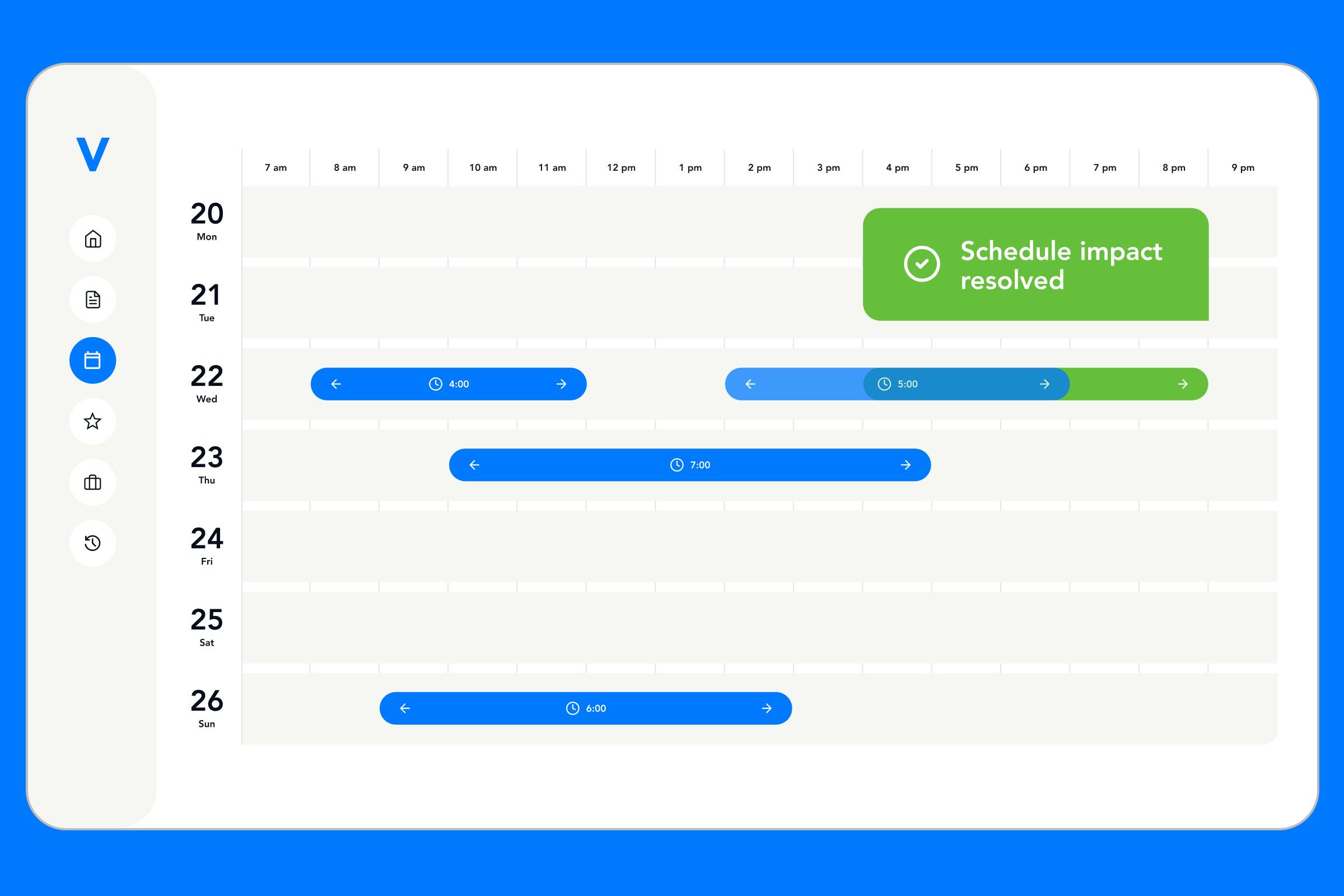
Intraday management
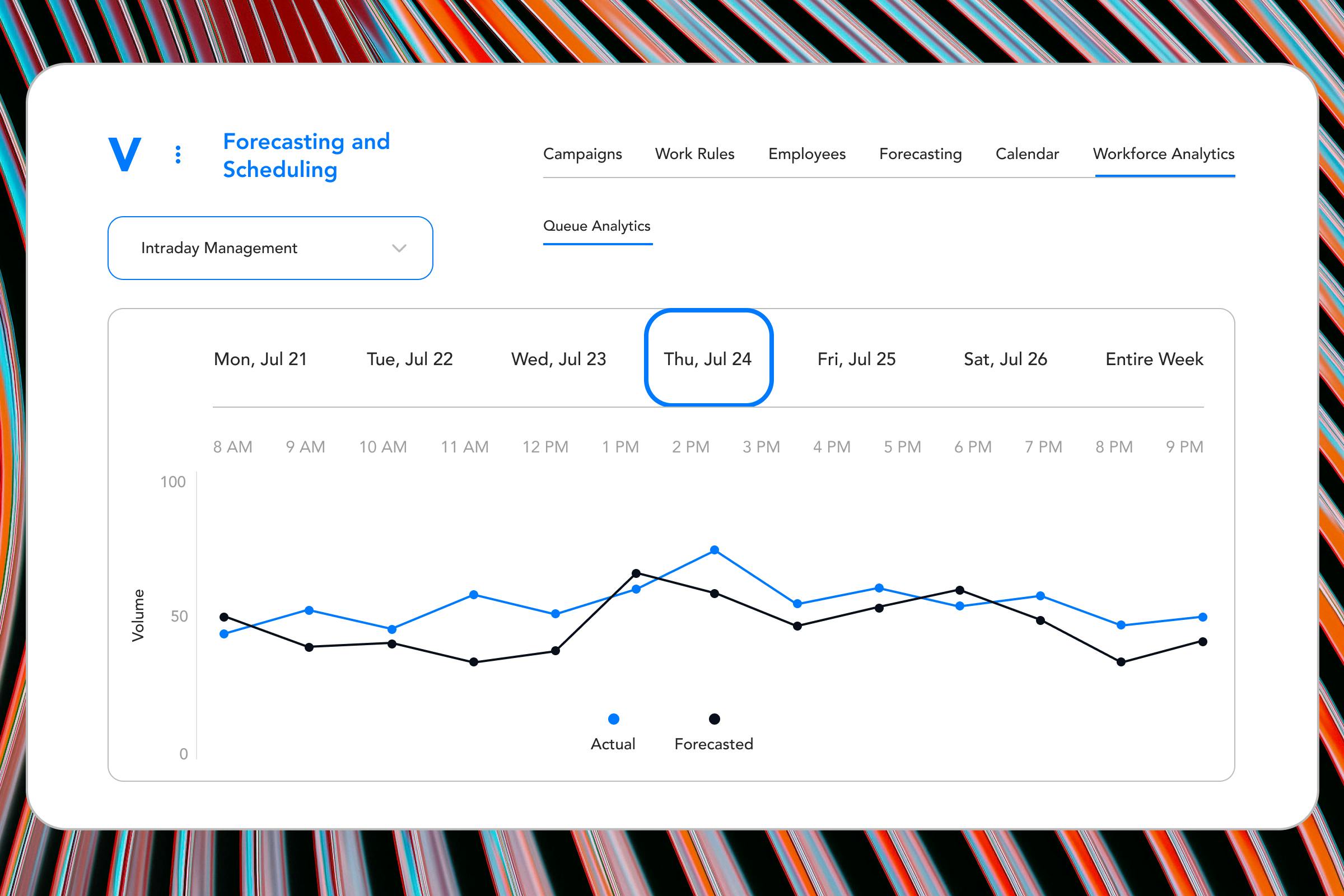
And just as employee scheduling needs often change, so can work volumes, types, and resource availability. Perhaps the flu goes through your contact center, and you have five unexpected call outs. Or marketing launches a last-minute promotion that increases inquiries. Intraday management provides analysts with a comparative view of forecasted, required, and actual volumes and statistics at an intra-daily and weekly level to facilitate reforecasting and schedule re-optimization to ensure agents are in place to manage customer interactions even during demand fluctuations.
Standard intraday management
Managers can use this data and insights to proactively address variations to their plan.
- Quickly compare forecasted vs. actual volumes and staffing (track forecasted, required, and actual data for key metrics from all sources).
- If interactions are below projected, managers can offer voluntary time off to employees.
- If volumes are high, they can offer overtime, extra shifts, or turn on a call-back feature to reduce wait times and call abandonment.
- Monitor employee schedule adherence on a single screen for both phone and desktop activities, and for in-house and remote employees, so you can proactively adjust to ensure service levels are met.
- Use real-time queue analytics capabilities to view each queue and how many interactions there are per queue and per hour to determine if enough resources are available to handle queue volumes.
Advanced intraday management
Modern WFM technology continuously analyzes intraday performance and recalculates demand and resource availability. The solution identifies differences between published schedules and real-time staffing needs and automatically:
- Sends alerts to impacted managers.
- Offers qualified agents overtime or voluntary time off based on how the center is performing. Organizations can set the rules and parameters to resolve intraday over or understaffing scenarios.
AI-powered intraday management
AI-powered dashboards and automated alerts surface intraday metrics, anomalies, and performance trends instantly, enabling managers to identify issues, drill into root causes, and take immediate corrective actions. This real-time intelligence supports both centralized and site-level management models across multi-site, remote, or hybrid teams, driving consistent operations and compliance enterprise wide.
Performance tracking
To ensure continuous improvement and goal achievement, contact centers need a way of measuring performance. Most automated WFM solutions include built-in, role-based scorecards and dashboards that provide real-time and intraday visibility into key performance metrics, enabling timely feedback and course correction, helping staff close skill gaps efficiently without manual oversight.
Standard performance tracking
Key performance tracking and management capabilities enable you to:
- Automate the capture, calculation, and presentation of key performance indicators (KPIs).
- Centralize performance tracking and management of WFM-related metrics, including schedule adherence, hold times, handle times, shrinkage, etc.
- Identify performance issues and, through integrated workflows, assign targeted coaching and education, fostering continuous professional growth and skill enhancement for employees.
- Support a continuous, data-driven feedback loop where goals are set, measured, and recalibrated regularly across the organization.
Advanced performance tracking
Advanced performance management includes the use of external data to build fully customizable KPIs, performance scorecards, and dashboards, expanding the metrics measured to include things like quality scores, CSAT, NPS, sales/cross sell rates, and more.

Reporting and real-time dashboards
Automated WFM solutions provide a breadth of robust reporting and customizable dashboards that include:
- Historical reporting and trend analysis across all interaction channels
- Drill-down capabilities
- Adherence and performance tracking
- Forecasting and scheduling analytics
- Real-time intraday workload monitoring
- Service level alerts, and more.
Visibility into performance extends beyond the manager to the agents themselves with access to personalized, real-time performance scorecards, promoting transparency and employee engagement.
Advanced reporting
Advanced workforce management software enables workforce and performance management across functions, consolidating data from the contact center, back-office, and branch to create an enterprise view of performance to promote efficiency, resource sharing, and process improvement. Users of all types can review personalized, curated, automatically generated dashboards. With unlimited dashboards, users can see any data, in any format, at any time.
AI-powered reporting
Modern AI workforce management tools help you move beyond limited, pre-defined reports to get a holistic view of your interaction data. AI can proactively mine your interaction data and surface anomalies, trends, and correlations you didn’t know to look for. These tools also include conversational AI capabilities, enabling you to query your data, search for insights, and drill down into granular details using natural language. This helps deliver real-time insights that can dramatically shorten the time to discover and fix new issues within your business.

Integrations and scalability
WFM solutions need to be able to grow with your organization, from small 50-person contact centers to global enterprises with thousands of agents across different sites, countries, and time zones. Enterprise-grade WFM solutions are open, enabling you to easily integrate with different telephony providers, channels, and your existing HR, CRM, and ACD workflow systems. These solutions have flexible deployment models, from on-premises to hybrid to single-tenant or multi-tenant cloud environments.
Advanced enterprise capabilities
While WFM grew up in the contact center, modern WFM technologies have purpose-built functionality that enables them to expand beyond the contact center into back-office, customer support functions and branch/distributed locations. Examples of functionality and unique attributes that need to be factored into the effective management of resources in these areas include:
- Back-office, customer support functions
- Backlog/inventory volumes and aging
- Extended SLAs
- End-to-end process and work-item tracking for complex, multi-step processes
- Hundreds of work types, each with different handle times and turnaround goals.
- Branches
- Dual controls: Instances when two people are needed for opening/closing the branch, open/closing the vault, etc.
- Physical attributes, such as drive-up windows, ATMs, and safe deposit boxes.
- Open hours by day-of-week, which can be different from branch to branch.
- A mix of lower volume, high duration sales interactions and higher volume, lower duration service interactions.
Questions to ask before selecting a WFM solution
When selecting an automated WFM solution, there are questions you should ask to ensure the solution can grow with your organization, continuing to modernize and harness the latest AI models to help you increase operational efficiency, maximize resource utilization, improve employee experience, and meet your CX and service goals. Here’s a list of some suggested questions.
Key capabilities
- Can the solution manage an omnichannel contact center workforce, creating forecasts and staffing plans that include all channels and work types, factoring in handle times for both immediate and asynchronous work?
- How flexible are the scheduling capabilities? Can the solution give agents the power to make changes while still protecting your service levels and adhering to business rules and labor laws?
- Does the solution enable profiling of agent and employee skills and proficiencies to support alignment of interaction types to available agents—and the sharing of resources across teams and functions to help manage volume fluctuations?
- Can the solution automatically alert you when there are deviations between forecasted and actual volumes during the day and automatically take actions to mitigate either an overstaffing or understaffing situation?
- Does the WFM solution include performance tracking and customizable dashboards for real-time visualization of achievement vs. goals across WFM and other performance KPIs?
- Can you search the WFM data using natural language querying?
Technology and deployment
- Are the key components of WFM (forecasting, planning, scheduling, intraday management, performance management, and reporting) included in the WFM pricing, or are any of these components add-ons?
- Can the WFM solution grow and scale with my organization, across the contact center, with BPO partners, and into the rest of the enterprise?
- Is the solution open and able to function across different telephony providers and channels—and within my existing ecosystem?
- Do I have deployment options, including on-premises, hybrid, or full cloud, both single and multi-tenant?
Business outcomes and ROI of modern WFM technology
By deploying modern WFM technology and leveraging AI-powered specialized bots, contact centers can maximize utilization, drive down costs, and improve service levels all while elevating the customer and employee experience. Organizations using Verint Enterprise Workforce Management have benefited from:
The Verint difference
Contact centers realize that hiring more workers and increasing labor expenses is no longer a sustainable solution. To achieve your strategic goals, you need a new approach to managing the workforce that increases agent capacity and utilization while still meeting your service goals.
Verint, the CX Automation Company™, has been a leading provider of workforce management software for over 20 years. We are a true enterprise solution that enables you to scale as you grow and expand beyond the contact center with purpose-built functionality for the contact center, back-office, and branch.
- DMG Consulting LLC has named Verint a leader in the enterprise WFM market for over a decade (2025 Workforce Management for the Enterprise, DMG Consulting LLC).
- Verint received top customer satisfaction scores (5.0 out of 5.0) on all 35 criteria spanning WFM vendor satisfaction, suite modules, and product capabilities in DMG Consulting’s 2024 Workforce Management for the Enterprise in the Digital Era report.
- Verint customers rank Verint Enterprise Workforce Management a Buyer’s Choice 2026 on TrustRadius and Top Rated 2025 and WFM Leader, Winter 2025, on G2.
- Verint TimeFlex Bot was voted Product of the Year 2024 by TMCnet.com and received a Gold 2025 Stevie Award for Sales & Customer Service.
“The software is very user friendly and straightforward. Agent and manager processes are easy to teach and understand. Request Management is easy to update.”
Configuration Analyst, Major Online Retailer, G2
At the core of Verint Open Platform is Verint Da Vinci™ AI and the Verint Engagement Data Hub. Leveraging Verint Da Vinci AI, which combines the best generative AI and commercial, customer-provided, and proprietary AI models, Verint has built specialized, AI-powered bots that automate workflows, increasing speed, accuracy, and capacity of your agents and managers. Verint Engagement Data Hub ensures you have the most comprehensive, real-time interaction, workforce performance, and customer experience data to drive faster, stronger decision making.
In addition to our automated workflows and AI forecasting algorithms, we’ve launched Verint TimeFlex Bot™ and Verint Interviewing Bot™ to drive business outcomes, now, and more AI WFM tools are currently in development.
Contact centers will continue to face increasing challenges. With Verint’s modern WFM solutions, your organization can harness the power of AI to deliver better customer and employee experiences at a lower cost.
Wrap up
- Cost-effectively meet your service goals by ensuring you have the right resources, with the right skills, at the right time with modern WFM technology.
- Reduce attrition and hire the best agents with AI-powered solutions that give employees self-service capabilities for scheduling and enable you to evaluate candidates based on your highest performing agents.
- Improve the employee experience with highly flexible, automated time off and schedule change management; easy, 24/7 access to schedule and performance data with mobile app; and transparent performance metrics and goal tracking.
- Reduce the burden on managers and speed response times by automating the request management, notifications, and actions needed to address intraday volume fluctuations.
- Future proof your investment in WFM by selecting a solution that can scale with your organization, extend across the enterprise, integrate with your existing systems and channels, provide flexible deployment options, infuse AI, and adapt as AI capabilities evolve.